


Rising energy costs and aging infrastructure put pressure on healthcare budgets and operations. Cenergistic partners with hospitals, clinics, and healthcare systems to lower utility expenses without compromising patient care.
Powered by the patented Cenergistic Optimize® platform, our proven approach improves efficiency, reduces waste, and strengthens system reliability. The result is healthier environments for patients and staff as well as stronger financial outcomes for your organization.
01
02
03
Hospital energy consumption runs around the clock, and it runs differently than almost any other building type. Operating rooms, imaging suites, sterile processing, and patient wings all demand tight environmental control 24 hours a day, so the usual playbook of turning things off after hours does not apply. That’s exactly why facilities teams are often reluctant to touch anything at all — understandably, since any change carries the risk of affecting patient safety or comfort.
The opportunity is not in doing less. It is in doing the same work more precisely. Most healthcare campuses are running HVAC, air handling, and central plant equipment on schedules and setpoints that were never recalibrated after the building’s original commissioning, even as occupancy patterns, equipment loads, and code requirements changed around them. That gap between what a system was built for and what it is actually doing today is where hospital energy management earns its return, without touching a single patient care protocol.

Air changes, humidity control, and pressure relationships in critical spaces often run wider than code requires, not because anyone chose that, but because no one has re-verified it in years.
Central plants, air handlers, and boiler systems already installed in your facility usually have more efficiency left in them than a capital replacement budget would suggest.
Every adjustment is measured against your actual utility data, so finance and facilities leadership see the same number and can defend it to a CFO or board.
For most healthcare campuses, HVAC accounts for the largest share of the utility bill and the largest share of unrealized savings. There is no single published figure for average energy usage for a hospital HVAC system, since load varies enormously by climate zone, bed count, and the mix of critical spaces on a campus, but HVAC and air handling typically represent the single largest energy end use in acute care facilities, well ahead of lighting or plug loads.
That makes energy efficient HVAC systems in hospitals less about replacing equipment and more about how existing equipment is sequenced, scheduled, and monitored. Our engineers work directly with your existing building automation system to:
Because none of this requires capital investment or new equipment, HVAC hospital energy savings typically begin showing up in utility data within the first few months of a program, well before any longer-term system upgrades would even be scoped.

Real experiences from organizations turning energy savings into lasting change.
“The Energy Program has empowered us to approach energy management strategically by reducing consumption, boosting efficiency and making smart reinvestments that benefit the entire UK community. We’re proud of the progress and excited to build on it.”
Vice President for Facilities Management
and Chief Facilities Officer (retired)
University of Kentucky
“Everything that they said they were going to do, they did. They saved us money; they provided the support.
… If my budget is $10 million, I’m going to spend $10 million and give it to the utility company—but if I can take $2 million of the $10 million and put it in classrooms for kids, that’s a no-brainer.”
Retired Chief Operating Officer,
Johnston County Schools, North Carolina
“Before partnering with Cenergistic, we didn’t even know where our energy was going—just that we were using too much. Now, energy conservation is part of our culture. Our schools compete to save the most, our principals are engaged, and our teachers see the savings going directly back to them. It’s not just about dollars—it’s about doing what’s right for our students, our staff, and our environment.”
Chief Operating Officer,
Pinellas County Schools, Florida
“Working with Cenergistic has been a game changer for our district. We’ve already seen significant improvements in our energy efficiency and overall building performance under the current program we have in place. Now, the retro-commissioning process has optimized our Building Automation System, resulting in additional energy savings and enhanced comfort for our students and staff.”
Associate Superintendent,
Facilities & Construction,
Pasadena ISD, Texas
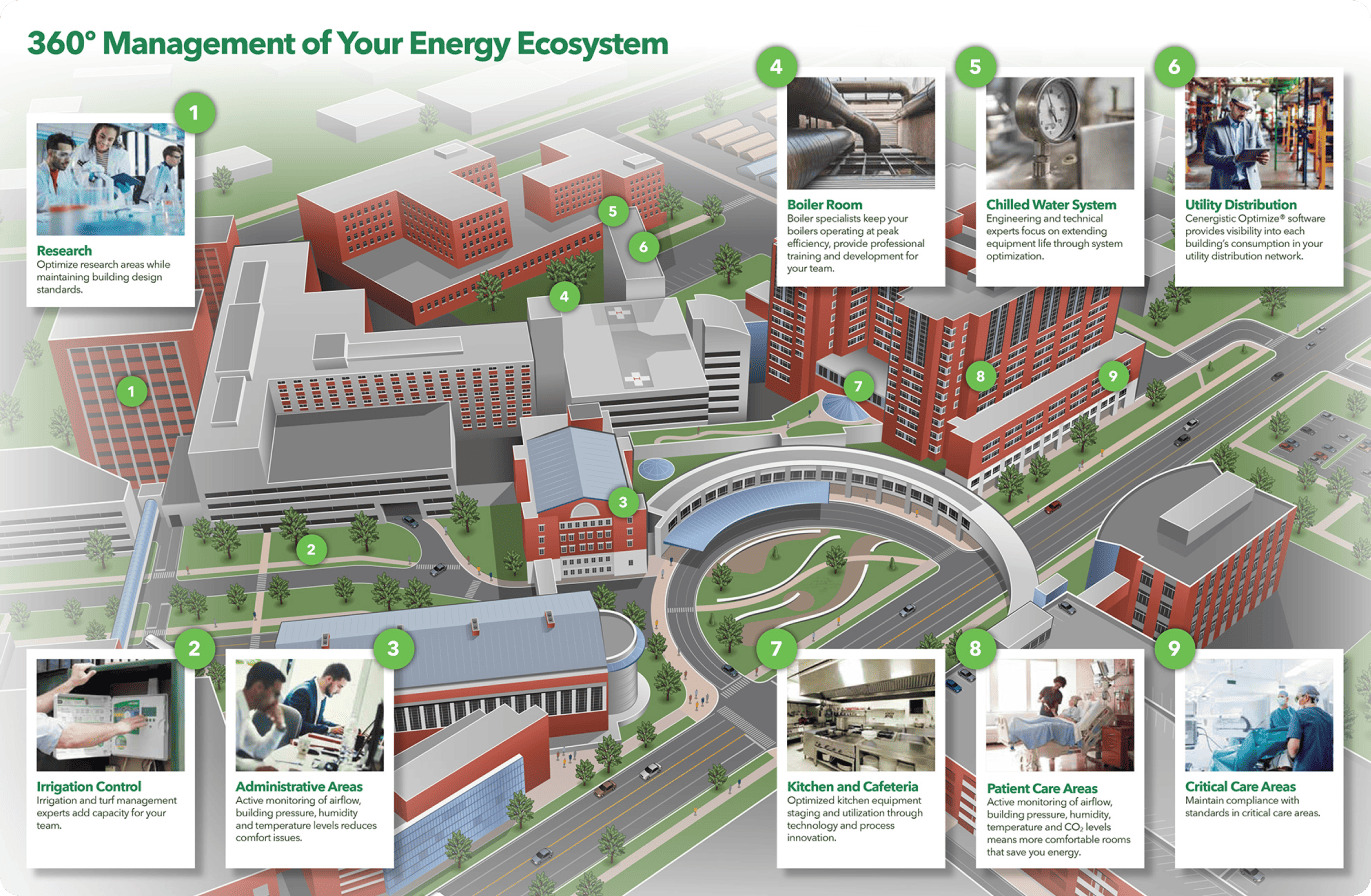
Cenergistic delivers end-to-end energy management tailored for the demands of healthcare operations. By combining AI-powered technology, continuous monitoring, and expert support, we help uncover hidden inefficiencies, drive rapid improvements, and sustain long-term savings. A user-friendly platform provides leadership with full visibility into energy use, validated savings, and facility performance across the entire system.
Yes. Hospital energy efficiency improvements can be planned around clinical operations rather than against them. Requirements for air quality, pressure relationships, and infection control in critical spaces come first, and changes are coordinated with the facilities team so patient care is not affected.

Discover how your hospital or healthcare system can reduce energy waste, extend equipment life, and reinvest in patient care with no capital required.